Graduate Research
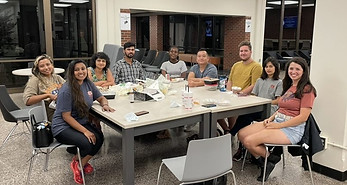
Please click on the "Lab Group Page" to see the research that my lab group, UrbanPRism, (pictured here) is currently conducting. Working in a diverse lab group has been helpful in being able to see how others are doing research that is related to what I am doing, and how they are using their backgrounds to shape their theses. Being in a lab group has also taught me how to be able to work with others on the same issue, even if everyone comes from a different background.
The current question I will be addressing in my thesis is how can the potential for damage by tropical cyclones to medium-sized cities along the Gulf of Mexico be determined, and what can be done to lower the potential? To answer this, 3 main objectives appear with the following methods:
1) Evaluate the risk of tropical cyclones using Hazus, a risk-estimating program developed by FEMA.
2) Create a social vulnerability index of each study site.
3) Test to see if there is any spatial autocorrelation between areas of risk and areas of social vulnerability.
Each study site is medium-sized, meaning it has a population of between 70,000 - 200,000 residents. My chosen study sites are Brownsville, TX, Lafayette, LA, Gulfport, MS, Mobile, AL, and Cape Coral, FL. Medium-sized cities are often overlooked during hazardous events since larger cities (such as Miami, New Orleans, and Houston) get much more media attention, but are still important to examine. Scientists predict that tropical cyclones may increase in intensity in the coming years due to climate change rising sea surface temperatures. This makes risk and resilience assessments key to helping a vulnerable community prepare, evacuate, and recover from a tropical cyclone.
This research is important because it will save money and save lives. The Gulf of Mexico is the fastest-growing region in the country, putting more lives and assets at risk when they strike the area (which will happen as tropical cyclones are known to strike the Gulf of Mexico). Hundreds of billions of dollars are also spent on tropical cyclones each decade, and if mitigation techniques were utilized upfront, the costs of tropical cyclones would decrease.
Undergraduate Research
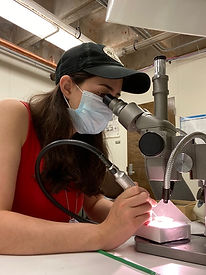
This is a photo of me drilling a carnivore tooth to sample for my project.
My main areas for my undergraduate research were vertebrate paleontology, paleoecology, and paleoclimatology. I was involved in research with the Florida Museum of Natural History in the Department of Vertebrate Paleontology since my second year. My project was focused on using stable isotope geochemistry to give insight to predator-prey relationships and dietary behaviors of carnivores of the White River Group (specifically Northwestern Nebraska) throughout the Eocene-Oligocene Transition (~34 Ma). This is the first isotopic study of carnivore isotopes for White River Group carnivores, making it a challenging, but exciting project. Currently, more samples are being collected to further our initial findings and make our research submittable for publication. While conducting this research, I learned how climate change can affect ecological relationships, and this helped to make me interested in current climate change issues. Through my research, I was able to participate in 3 weeks of fieldwork out in Oglala National Grassland and Toadstool Geologic Park in Northwestern Nebraska. This was a valuable field experience and it was exciting to be able to collect my own specimens.

Here is a photo of me in Oglala National Grassland during my 2019 fieldwork season to gather samples for my project.
To me, both of the images shown here show the two parts of science: going out into the field to retrieve samples, and going to the lab to analyze the samples. Being able to participate in both of those has allowed me to be involved in every step of my project. Not only did I have a lot of fun when I was in the field, but I learned the process that goes into collecting samples; it is not as easy as just picking up a fossil and putting it in a bag. I experienced a similar thing in the lab. One might see the drilling photo and assume I am drilling the tooth to bits. However, there were specific teeth chosen to drill, specific drilling locations on each tooth, and specific amounts of powdered samples were considered when drilling. While I may not be involved in vertebrate paleontology, paleoclimatology, and paleoecology academically, I am still involved in this project and am currently working to gather more samples to increase our size and find equipment capable of drilling teeth and testing for the specific isotopes we need. The experience in these areas of geology has shaped how I understand the scientific method and all the work that goes into a project.
Publications and Presentations
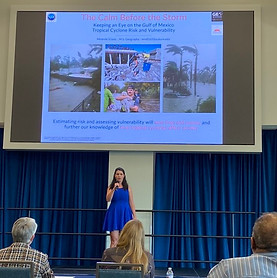
Oral Presentation, 3 Minutes Thesis Competition, Auburn University, November 2022.
Silano, M. The Calm Before the Storm: Keeping an Eye on the Gulf of Mexico Tropical Cyclone Risk and Vulnerability.
Poster Presentation, Southeastern Division of American Association of Geographers, November 2022
Silano, M., Mitra, C. Estimating the Risk of Wind Damage from Hurricanes to Medium Sized Cities Along the Gulf of Mexico.
Poster Presentation, Geological Society of America Connects 2022 Conference, October 2022
Silano, M., Mitra, C. Use of Geospatial Techniques in Estimating Risk from Hurricane Wind Damage.
Written Article, Discovering COSAM: Our Research Explained, Auburn University, Fall 2022
Silano, M. The Impacts of Tropical Cyclones on Coastal Communities.
Poster Presentation, International Association for Urban Climate, August 2022
Silano, M., Mitra, C. Application of GIS to observe potential hurricane wind damage along the Gulf of Mexico.
Video, Science Communication Class, Auburn University, April 2022
Silano, M. Hurricane Risk and Resilience: Keeping an “Eye” on the Gulf Coast.
Poster Presentation, 2022 NRT Climate Research Symposium, Auburn University, March 2022
Silano, M. Mitra, C. Assessing Vulnerability of Socially Underprivileged Populations Impacted by Tropical Cyclones Along the Gulf Coast.
Oral Presentation, Geological Society of America Connects 2021 Conference, October 2021
Silano, M., Moran, S., Ross, M., 2021. Stable Isotope Paleoecology of Carnivores During the Eocene-Oligocene Transition of Nebraska. Abstract DOI: 10.1130/abs/2021AM-364272
Written Article, Professional Geology Class Project, December 2020
Silano, M. More Than Just Rocks: Public Perception of Geology.

2022 NRT Climate Research Symposium Poster
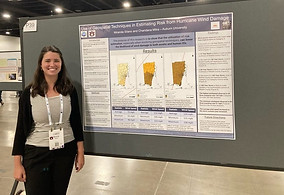
Geological Society of American Connects 2022 Conference
3 Minute Thesis Competition
Short Courses
I have included information about short courses here to demonstrate my initiation of gaining relevant information beyond the classroom and seeing climate hazards and emergency management issues from several different perspectives. It has brought to my attention how concepts I am learning in class do apply in "real-world" situations. These courses have also helped me design my thesis to where the information gathered can be used successfully by a stakeholder. The certificates have been included to show proof of attendance and completion.
Coastal Hazard Awareness (AWR-379)
National Disaster Preparedness Training Center (NDPTC)
2021, Federal Emergency Management Agency (FEMA) Certified
Climate Adaptation Planning for Emergency Management (AWR-347)
National Disaster Preparedness Training Center (NDPTC)
2021, Federal Emergency Management Agency (FEMA) Certified
Hurricane Awareness (AWR-343)
National Disaster Preparedness Training Center (NDPTC)
2022, Federal Emergency Management Agency (FEMA) Certified